Bruxism & Snoring Devices
A quieter night, a protected smile
Custom guards for grinding, jaw pain, and snoring
Grinding wears down teeth while you sleep and snoring keeps you and your partner awake. Both have a custom, digitally fitted answer, made to measure at the clinic rather than boiled at home.
Jaw Pain & TMJ
When the jaw joint needs help too.
Clicking, stiffness, or pain around the jaw joint often travels with grinding and clenching. A splint designed for TMJ symptoms can rest the joint and ease the muscles around it. We assess and adjust it alongside your bite as a whole.
Why It Is So Common
A habit of the modern age.
Tooth grinding or clenching, known in professional terms as bruxism, has become very common over the last decades. More stress, more pressure on our time and fewer opportunities to truly relax have all played their part. It arrives at the same moment that smile makeovers, using porcelain or zirconia crowns and veneers, have become hugely popular, which makes protecting those teeth from grinding more important than ever.
The Silent Damage
Wear you never feel.
If it is not addressed, grinding will inevitably lead to gradual wear and tear, making your teeth shorter and flatter over the years. Most of the time it causes no pain and no symptoms at all. Because of that, many patients do not realise how much tooth height and structure they have lost until the damage is severe, and can no longer be resolved without a full-mouth restoration.
Our First Visit
Caught in time.
This is why, as a standard protocol, we examine every patient thoroughly at the first visit. We check the joints, the muscles and the bite, as well as the structure and anatomy of the teeth, so we can spot the early signs and act in time to preserve your own teeth while there is still something to preserve.
After a Makeover
The bite is everything.
If you have already had a full-mouth makeover with veneers or crowns, it is of the utmost importance that the dentist secures an ideal bite between every tooth of the upper and lower jaw. Any premature contact overloads the teeth that meet first. That tooth can loosen under the excessive pressure, or the restoration on top of it can loosen, fall off or fracture, especially in a patient who is prone to grinding through their environment or their genetics.
Harder Than Enamel
Porcelain never wears in.
Porcelain, and zirconia even more so, is far harder than natural tooth enamel. Many patients think this is a good thing. But on a natural tooth, small inaccuracies in the bite tend to correct themselves over time through a little natural wear. With veneers and zirconia crowns that never happens, because they allow no wear at all. Think of a plate in your kitchen: after thirty years it looks exactly as it did on day one, because porcelain does not change in size, shape or colour. For that reason, the restorative dentist must spend real time, attention and patience adjusting your bite once the veneers and crowns are in place, so that the whole mouth meets in balance and nothing is left to trigger grinding.
The Right Guard
Why the guard is hard.
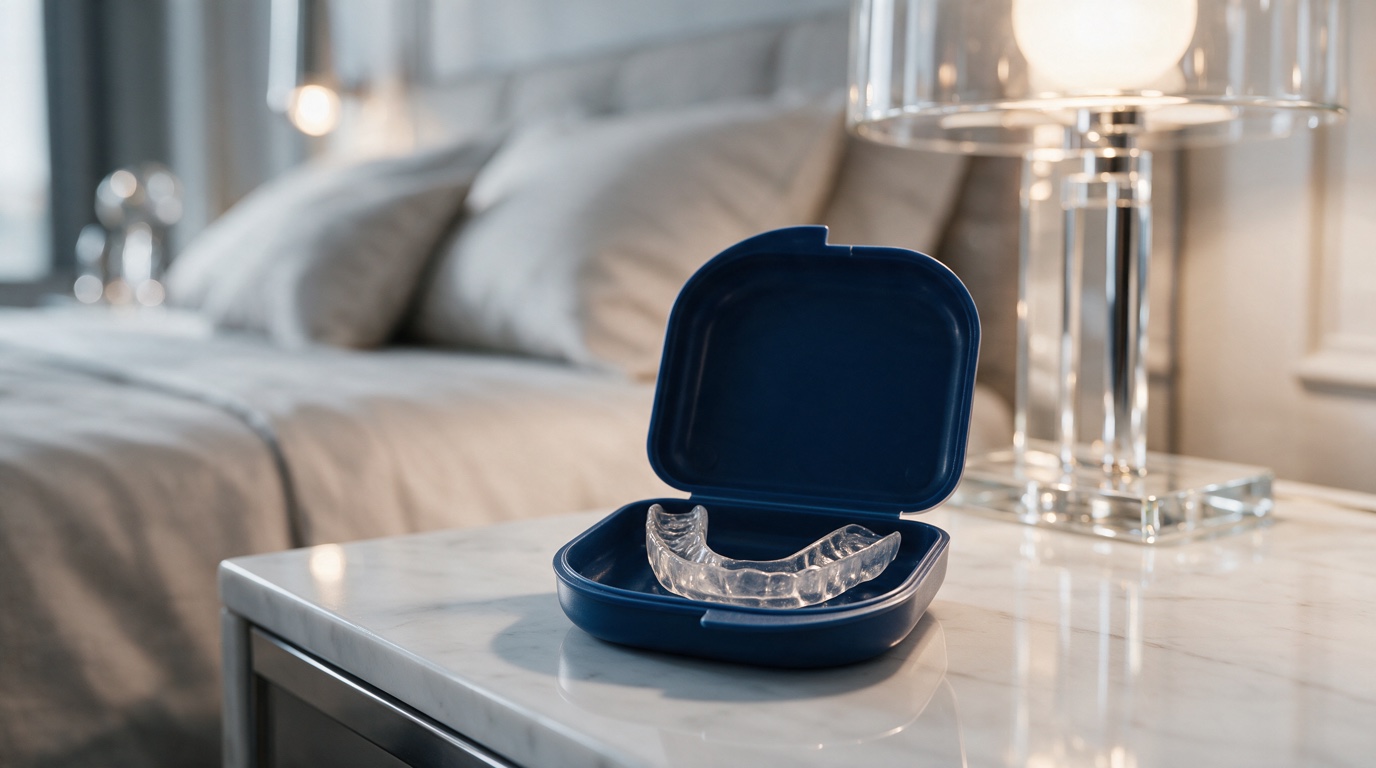
Our custom mouthguards are made of hard resin. We strongly advise against over-the-counter products: they give a false sense of safety while doing little to protect your teeth. A soft or medium-soft guard will most often act as a trigger instead. Think of chewing gum, which only makes you chew more and more. Now think of the moment you accidentally bite on a spoon, an olive pit or something hard: your teeth open wide at once. A hard guard works on that same reflex. It helps reduce the clenching and grinding while relaxing your chewing muscles and your jaw joints.
What Patients Tell Us
Sleep they won't give up.
It fills us with gratitude to see how well these mouthguards work for most of our patients. The feedback is remarkable. Many notice that their sleep has become calmer and deeper, and that they wake up more relaxed, with less tension in the head and elsewhere. They grow so used to waking up this way that they find they cannot really sleep without it, and become quite desperate on the rare occasion they misplace or lose it.
How It Works
01
Exam & Assessment
We examine wear patterns, jaw muscles, and, where snoring is the concern, ask about airway and sleep history.
02
Digital Scan
A quick digital scan of your bite replaces putty impressions and gives the lab an exact model to work from.
03
Fitting & Calibration
Your custom device is fitted and, for snoring appliances, calibrated to the right jaw position for you.
04
Review & Adjustment
We check comfort, fit, and results at a follow-up visit and fine-tune the device as needed.
Protect Your Smile
Stop the grinding before it costs you.
A free check-up tells us whether it's a night guard, a snoring device, or both, and what it will cost, in writing, before anything is made.
Book Your Free Check-Up